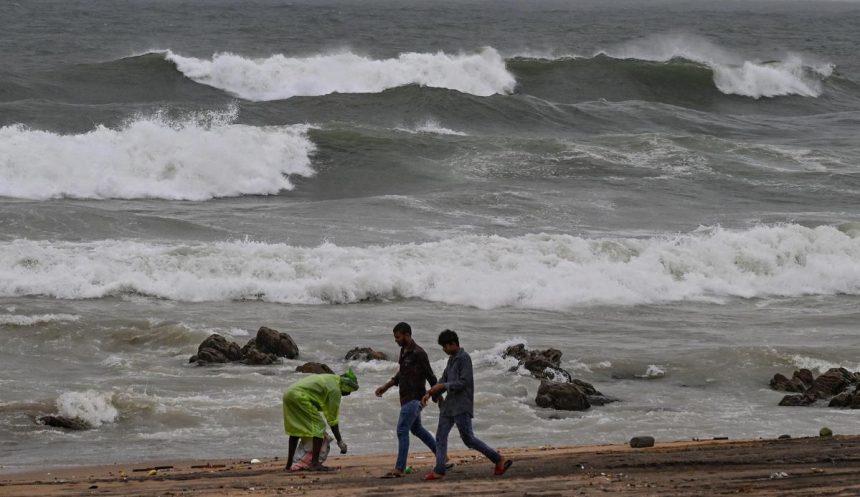
Cyclone Montha has made landfall as a severe cyclonic storm near Kakinada on the Andhra coast, bringing destructive winds and relentless rainfall. The India Meteorological Department (IMD) has confirmed wind speeds touching 110 km/h, with heavy to very heavy rainfall extending into southern Odisha.
The storm, which developed rapidly over the Bay of Bengal, has affected millions of coastal residents and triggered one of the biggest evacuation operations in recent years. Power lines, roads, and crops across East and West Godavari, Vizianagaram, Srikakulam, and Gajapati have suffered extensive damage.
Preparedness on the Ground
Andhra Pradesh
Andhra Pradesh Chief Minister N. Chandrababu Naidu declared a “state of full alert” three days before landfall.
- Red alerts were issued in 19 coastal districts.
- Nearly 38,000 people evacuated to relief camps.
- Over 1,200 disaster response workers deployed with satellite phones.
- Schools, markets, and government offices in vulnerable areas were closed for 48 hours.
- Real-time voice alert systems and flood-gate control monitoring were activated in critical zones like Amalapuram and Yanam.
District authorities coordinated with the State Disaster Management Authority (APSDMA) and NDRF, ensuring food packets, dry rations, and water supplies reached shelters before the cyclone hit.
Odisha
Odisha, still carrying lessons from past storms like Phailin and Fani, moved swiftly.
- CM Mohan Charan Majhi chaired back-to-back meetings, directing officials to achieve “zero casualties.”
- Over 200 boats and 50 power boats were stationed along Ganjam and Gajapati coasts.
- Odisha Disaster Rapid Action Force (ODRAF) teams remained on high readiness in vulnerable regions.
- Train services suspended between Berhampur and Rayagada.
Local panchayats were mobilized to assist with evacuation, making Odisha one of the few states with a truly community-led disaster network.
Official Warnings and Evacuations
The IMD issued consistent bulletins as Montha intensified from a deep depression to a severe cyclonic storm. Evacuation drives continued through the night before landfall, with over 50,000 residents shifted to safer zones.
All fishing operations were banned, and coastal highways sealed to avoid accidents. Over 70 flights and 35 trains were cancelled or diverted.
The Central Water Commission warned of rising water levels in the Vamsadhara and Nagavali rivers, posing flood risks in Odisha’s interior belts.
Political and Government Response
Andhra Pradesh Chief Minister Naidu conducted reviews from the RTGS command center in Amaravati, stating,
“Our objective is simple — zero casualties, minimum damage, and fastest recovery possible.”
His administration has announced ₹250 crore in immediate relief and promised compensation for crop loss and housing damage once assessment reports are finalized.
Odisha
Odisha’s Majhi government focused on decentralised response, allowing district collectors emergency spending powers up to ₹5 crore. Relief camps were stocked with essentials, and women’s SHGs were mobilised for community kitchens.
Central Government
The Union Home Ministry is closely monitoring developments. Union Home Minister Amit Shah reviewed preparedness with both chief ministers via video conference. The Centre has approved 12 additional NDRF teams, while the Indian Air Force kept transport aircraft and helicopters on standby in Visakhapatnam and Bhubaneswar.
The Prime Minister’s Office (PMO) said in a statement that “every necessary support will be provided to affected states”, calling it a test of India’s coastal disaster readiness.
Ground Reality: Damage and Challenges
Preliminary reports suggest that Kakinada, Amalapuram, and Srikakulam bore the brunt of Montha’s fury.
- Over 38,000 hectares of paddy and horticultural crops were destroyed.
- Nearly 1,200 electricity poles and 300 km of rural roads were damaged.
- Communication lines disrupted across multiple mandals.
Farmers in Konaseema told,
“We are used to floods, but this time, the winds have destroyed entire banana fields. It will take months to recover.”
In Odisha, uprooted trees and waterlogging have hit road connectivity in Rayagada and Koraput, while local authorities continue to clear blocked routes.
Despite early evacuation, many rural families complain of poor coordination and lack of drinking water at relief shelters.
The Political Barometer
Cyclone Montha is fast becoming a political stress test.
- For Naidu, who returned to power with promises of “smart governance,” this is the first major natural disaster under his new term.
- In Odisha, the BJP-led government will be measured against the high benchmarks set by previous administrations in disaster management.
While opposition leaders have demanded independent audits of relief delivery, both governments have appealed for patience. The narrative from the Centre emphasizes cooperative federalism in times of natural calamity.
On social media, citizens have hailed early warnings and timely evacuations, contrasting this response with earlier disasters where complacency cost lives.
The Road Ahead: Relief and Rehabilitation
Post-cyclone rehabilitation is already underway.
- Power restoration has begun in urban zones of Vizag and Bhubaneswar.
- Crop insurance surveys are being expedited under the Pradhan Mantri Fasal Bima Yojana.
- The Health Ministry has issued advisories on water-borne disease prevention in flooded regions.
Experts say Montha once again highlights the need for stronger climate adaptation planning, as India’s eastern coastline continues to face frequent high-intensity storms due to warming seas.