More than two centuries ago, a treaty signed in a small town in present-day Bihar quietly redrew the political map of the Himalayas. The Treaty of Sugauli, concluded in 1816 between the expanding British East India Company and the Kingdom of Nepal, not only ended a costly war but also defined borders that continue to influence India-Nepal relations to this day.
From Expansion to Conflict
In the late 18th century, Nepal under the Gorkha rulers was rapidly expanding beyond its original hill territories. Over a few decades, it extended control westward into Kumaon and Garhwal and eastward toward Sikkim. This expansion brought Nepal into direct contact—and eventually conflict—with the British East India Company, which was consolidating its power across the Indian subcontinent.
The frontier between the two sides remained poorly defined, especially in the fertile Terai region. Frequent disputes over land and jurisdiction gradually escalated tensions, making confrontation increasingly likely.
The Anglo-Nepalese War
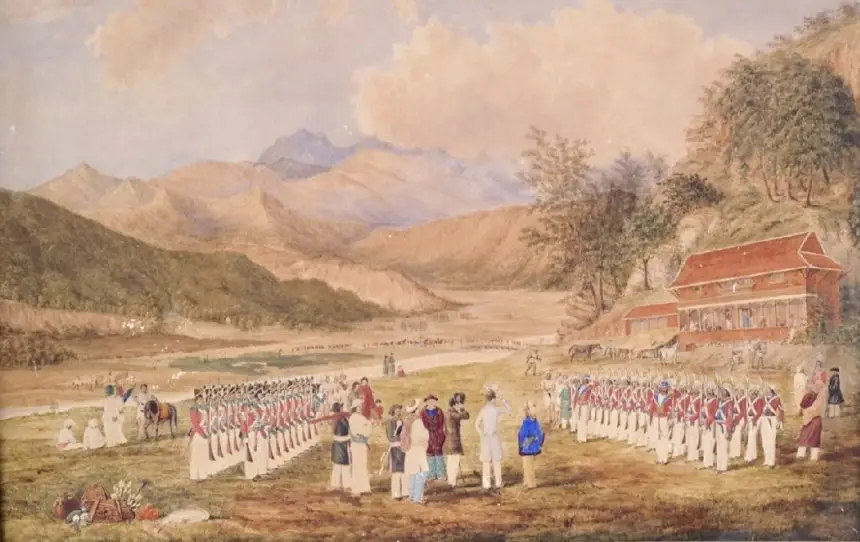
War finally broke out in 1814. The conflict, fought largely in mountainous terrain, initially favored Nepal. Its forces were well adapted to hill warfare and managed to resist British advances in several early engagements.
However, the British gradually turned the tide. With greater resources, stronger logistical support, and experienced leadership, including General David Ochterlony, the East India Company gained the upper hand. By 1815, Nepal’s position had weakened considerably, leading to negotiations for peace.
Terms of the Treaty
The Treaty of Sugauli was formally signed in March 1816, following earlier agreements reached in late 1815. Named after the town of Sugauli in present-day Bihar, the treaty imposed several significant conditions on Nepal.
The most immediate impact was territorial. Nepal ceded large areas to the British, including Kumaon and Garhwal in the west, as well as territories in the east that later became associated with Sikkim. Parts of the Terai region were also handed over, though some of these lands were restored to Nepal in subsequent arrangements later in the 19th century.
The treaty also defined Nepal’s boundaries. The Mechi River was set as the eastern limit, while the Kali (Mahakali) River became the western boundary. Although this appeared to settle the issue, the exact origin of the Kali River was not clearly specified, leaving room for future disputes.
Another key provision required Nepal to accept a British Resident in Kathmandu. This ensured a permanent diplomatic presence and allowed the British to observe political developments within the kingdom. While Nepal remained formally independent, this marked the beginning of sustained British influence in its external affairs.
In addition, Nepal’s freedom in foreign relations was restricted. The kingdom could not employ foreigners without British consent, limiting its ability to independently shape its diplomatic and military policies.
Impact on Nepal
The consequences for Nepal were substantial. At its peak, the Gorkha kingdom had controlled a vast stretch of territory across the Himalayas. After the treaty, it lost nearly one-third of this land, including economically valuable regions in the plains.
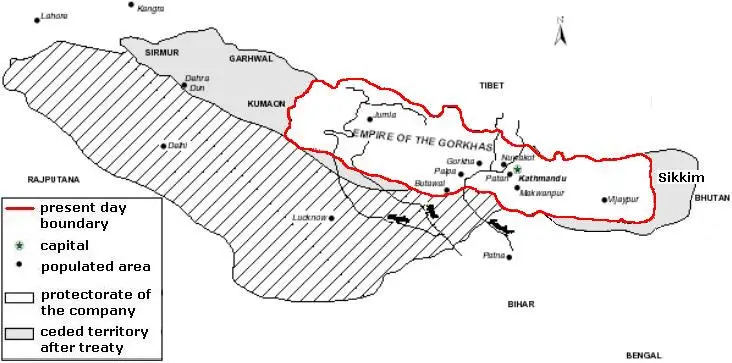
This marked a turning point in Nepal’s history. From an expanding regional power, it became a more territorially fixed state. Despite these losses, Nepal retained its sovereignty and avoided direct colonization, unlike many other parts of South Asia during this period.
Internally, the political structure of Nepal remained largely unchanged. The monarchy and ruling elites continued to govern without direct British interference in domestic affairs.
Strategic Gains for the British
For the British East India Company, the treaty was a major strategic achievement. It secured the northern frontier and reduced the threat posed by a capable and expanding neighbor.
The acquisition of hill regions such as Kumaon and Garhwal also gave the British greater control over Himalayan trade routes and improved their geographical reach in the region.
The war had also demonstrated the military capability of the Gorkha soldiers. Recognizing their effectiveness, the British began recruiting Gurkhas into their army, a practice that would continue for generations and become a defining aspect of colonial military history.
Long-Term Significance
The long-term importance of the Treaty of Sugauli lies in its enduring impact on borders and regional relations. The boundaries defined in 1816 continue to shape Nepal’s present-day frontiers with India.
At the same time, certain ambiguities in the treaty have contributed to ongoing disputes. The disagreement over the Kalapani region, for instance, stems from differing interpretations of the Kali River’s source as mentioned in the treaty.
The agreement also stands out as an example of a different kind of colonial relationship. Nepal was neither annexed nor reduced to a princely state. Instead, it maintained formal independence while accepting limitations that aligned it closely with British strategic interests.
More than two centuries after it was signed, the Treaty of Sugauli remains a key reference point in understanding the political geography of the Himalayan region. Its impact is visible not only in historical narratives but also in contemporary discussions on borders, sovereignty, and regional diplomacy.