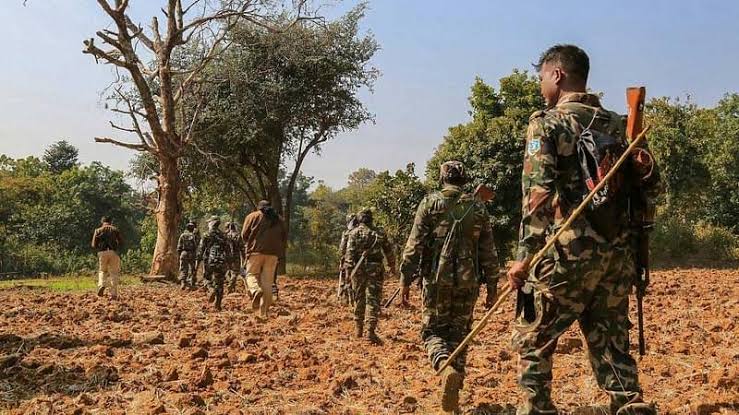
In a major Chhattisgarh Naxal encounter, security forces successfully eliminated 31 Maoists in Bijapur district, dealing a significant blow to left-wing extremism. The joint operation, conducted in the dense forests of Bijapur’s National Park area, also resulted in the loss of two security personnel.
This encounter is part of a broader strategy to eliminate Naxalism in Chhattisgarh, a state that has been a Maoist stronghold for decades. The government has intensified anti-Naxal operations, aiming for a Naxal-free India by 2026.
The Operation
Acting on specific intelligence about a large gathering of Maoist cadres, a joint team comprising the District Reserve Guard (DRG), Special Task Force (STF), and elite Commando Battalion for Resolute Action (CoBRA) launched a well-coordinated mission. As the forces approached the Maoist hideout, they were met with heavy gunfire, leading to an intense firefight deep inside the forest.
By the time the dust settled, 31 Maoists lay dead. However, the operation also came at a cost—two security personnel lost their lives in the line of duty. Their sacrifice serves as a stark reminder of the dangers faced by those fighting on the front lines against insurgency.
A String of Recent Successes Against Maoists
This encounter follows a series of intensified operations in Chhattisgarh’s Bastar region, a known Maoist stronghold. Just days earlier, on January 31, security forces had eliminated eight Maoists in another successful operation in the same district.

The government has been steadily ramping up efforts to root out Maoist influence, with Union Home Minister Amit Shah reiterating the commitment to completely eradicate Naxalism by 2026. The recent crackdown comes in the wake of a tragic attack on January 6, where an IED blast by Maoists in Bijapur claimed the lives of eight DRG personnel and a civilian driver.
A Step Towards Peace, But Challenges Remain
For decades, Maoist insurgency has plagued central and eastern India, with Chhattisgarh being one of the worst-affected states. The rebels, who claim to fight for the rights of tribal communities and landless peasants, have often resorted to violent means, targeting security forces, government officials, and even civilians.
The latest encounter is a big blow to the Maoist network, weakening their operational capabilities in the region. However, experts caution that a military victory alone won’t be enough. A long-term strategy, including better intelligence, local development, and efforts to win the trust of tribal communities, is crucial to ensuring lasting peace.
As security forces continue their operations, the hope remains that one day, the red corridor will cease to be a battleground, and the people of Chhattisgarh will finally see an end to the decades-long conflict. For now, the battle continues, and the sacrifices of our brave soldiers serve as a reminder of the price paid for peace and stability.